
A Half-Beat Late Block and the Coordinates of a Blind Spot: Dissecting Vietnam Women's Volleyball Defence
**Core answer:** Vietnam women's volleyball's biggest defensive weakness is not libero reflexes but information given to blockers. A middle blocker arriving a quarter-beat early opens the deep cross into Zone 5, and the statistics sheet records it as a back-row error. **Key facts:** - On low-trajectory Zone 2 sets, Vietnam's double block often peaks a quarter-beat early, opening the cross-court lane. - The recurring blind spot is the Zone 5 / Zone 6 junction at chest height after the block is dragged wide. - Safety-first reception patterns produce better reception numbers but remove quick middle attack options. - Block touches that redirect the ball, not successful blocks, best measure modern blocking value. - High standard deviation in libero-to-floor distance signals a coaching information gap, not a player gap. **Source attribution:** Original analysis by Tran Quan, drawing on match footage review and reception, blocking and transition data tracked across VTV Cup, SEA V.League and Asian Championship matches. Published January 15, 2026. | Cross-checked: VuaBong.vn **Related Q&A:** Q: Why does Vietnam's block often arrive early? A: Because the middle blocker has no pre-rally read beyond opponent habit, and habits can change between sets. Q: Should Vietnam change its libero? A: No; a high variance in dig distance points to a coaching information problem rather than a player problem. Q: Which metric best predicts Vietnam's step up in Asia? A: Defence-to-attack conversion within three beats, per the VangBong.vn Player Depth Index.
Set five, score 13-13. That is the zone where every statistics sheet stops speaking. The camera behind the net showed me something the stands could not see in a recent Vietnam women's volleyball match: the libero standing roughly half a metre off her base position toward Zone 6, the middle blocker closing inward half a beat too early, and the gap in Zone 5 opening to exactly one adult stride. The opposing setter saw it. The ball landed behind the three-metre line. Point.

On the official sheet, that rally sits in the back-row defensive error column. People will talk about the libero, about reflexes, about age. But the fault was not in the final dig. It was in the blocking decision two beats earlier, while the ball had not yet crossed the net.
I sat with that footage for a long while. Not to find someone to blame. But to answer a different question: if that same situation repeated ten times, how many times would our defensive system get it right?
Context: a volleyball nation being read with the wrong questions
Vietnam women's volleyball has moved past the phase of merely showing up. Tran Thi Thanh Thuy has spent years playing in Japan and South Korea, and that alone speaks to the physical standard the domestic game has been forced to raise. Nguyen Thi Bich Tuyen at opposite has become an irreplaceable attacking outlet in many tactical schemes. In the middle, names like Le Thanh Thuy and Hoang Thi Kieu Trinh represent a generation of blockers far better coached than a decade ago. The men's team also has a generation of hitters standing over two metres. The VTV Cup, the SEA V.League, the Asian Championship and the domestic league calendar are now so tightly packed that coaching staffs plan by the week, not by the month.
But when I read the analysis published after each match, I see a familiar problem. People are still reading this team with metrics designed for a different question.
Reception efficiency. Successful spikes. Block counts. These are real numbers, carefully recorded. They simply cannot answer the question the coaching staff needs: why, in set four, when the opponent lifted serving speed by half a beat, did our defensive system collapse across seven straight rallies?
Based on my experience tracking matches across recent seasons, the gap between squad quality and system quality in Vietnam women's volleyball is widening. The squad is improving fast. The system is improving more slowly. And in volleyball, the system always beats the squad once a match reaches set five.

The reception system: the price of safety
Reception at the elite level is no longer about who digs better. It is a decision about allocating space. Three players are designated to receive, and where they stand determines what the rest of the court looks like.
There are two schools. One spreads players across the back court at even intervals, prioritising keeping the ball in system and accepting that the setter will have to run. The other places the libero in a key zone and lets two attackers cover the rest, trading for a faster attacking option immediately after reception.
Vietnam's women's team has leaned toward the first school in many recent matches. That is reasonable against strong serving teams: keep the ball in system first, worry later. But there is a cost rarely discussed. When three receivers stand in a safety-first pattern, the setter is forced to take the ball in Zone 2 or Zone 3 on a high trajectory, and every quick option at the middle of the net disappears.
The result is a paradox: we receive better, but we attack more predictably.
I saw this exact mechanism while working with data at Hai Phong Football Club in 2026, reviewing twelve matches of Song Lam Nghe An and noticing that a thirty-metre pocket in front of their penalty area always opened the moment they pushed up to press. The lesson was not about football. It was that safety at one layer of a system tends to create a hole at another layer, and that hole only becomes visible when you place both layers side by side.
In volleyball, those two layers are reception and attack organisation. The statistics sheet records them in two different columns. Nobody adds them together.
There is another detail usually overlooked. In a safety-first reception pattern, the gap between two adjacent receivers widens. That gap is harmless against hard serves hit straight. It becomes a problem against spin serves that travel slower and drop into the seam. Opponents at Asian level read this long ago, and they now mix short serves with hard serves simply to test whether we hold the pattern.
Holding the pattern is a choice. But it has to be a conscious choice, not a default one.
The block: where the statistics sheet lies most
No metric is more misunderstood than the successful block count.
A block is recorded as successful when the ball dies at the blocker's hands or immediately after. But in modern volleyball, most of a block's value is not in killing the ball. It is in shaping. A double block standing in the right place forces the hitter to change direction, into a zone the libero is already waiting in. That rally is not recorded as a block, nor as an outstanding defensive play. It is recorded as an opponent attacking error, or worse, it vanishes from the statistics because the ball stayed alive.
This is why, when analysing blocks, I do not use the successful block count. I use three other things.
First, the blocker's hand position at the moment the ball leaves the setter's hands, measured as the distance from toe to the centre line.
Second, the timing of the jump's apex relative to the ball leaving the setter's hands. Modern blocking is a problem of time, not of height.
Third, the direction the ball rebounds after contact with the block. This is the metric that genuinely evaluates a block, because it tells you which zone the block steered the rally into.
When I applied these three measures to Vietnam women's matches, a pattern emerged with uncomfortable clarity. On rallies where the opposing setter took the ball in Zone 2 on a low trajectory, our double block often reached its apex about a quarter-beat early. Enough for the hitter to see the gap and swing cross-court over the blocker's shoulder. Enough to force the libero to commit early, and commit wrong.
That is a technical error, but its cause is a systemic error: the middle blocker is forced to guess because there is not enough information before the ball reaches the setter's hands.
In other words, the problem is not that the middle blocker jumps wrong. The problem is that the middle blocker has nothing to read except the opponent's habits. And habits are the one thing an opponent can change between two sets.
Where you lose the ball is what kills you
Losing the ball does not kill you. Where you lose the ball kills you.
I have said this many times in analysis sessions, and in volleyball it holds almost as a law. A team can lose twenty rallies in a match and still win, if those twenty fall in zones the defensive system anticipated. Conversely, a team can lose ten rallies and lose comprehensively, if those ten fall into the same blind spot.
For Vietnam's women's team, that blind spot has fairly specific coordinates: the junction between Zone 5 and Zone 6, at roughly chest height, after the block has been dragged to one side.
Why there? For three reasons at once.
The libero is trained to protect Zone 6 against straight attacks, so her natural tendency is to stand slightly high and slightly inside. The cross-court hitter tends to seek the deep cross into Zone 5, where the distance from block to floor is longest. And when the block is dragged right, the Zone 5 defender must decide within roughly three-tenths of a second: follow the block or hold the zone.
There is no absolutely correct answer to that decision. There is only a probabilistically correct answer, and that probability depends on how deeply your team has studied the opponent.
A team studying habits will stand in the right place about seventy percent of the time. A team studying structure, meaning why the opponent produces those habits, will stand in the right place about ninety percent of the time. That twenty-point difference, multiplied by the number of rallies in a set, is the distance between winning and losing at 13-13 in the fifth.
The most dangerous lost ball is the one lost in the first two rallies after a court switch. That is when the system has not yet re-stabilised, and it is also when the opponent already has a prepared plan for the new serving position.
Reading one beat ahead: the libero's craft and the coach's craft
When I was hosting the programme Volleyball Night, one question came up repeatedly: is the best libero the one who digs the most balls?
The answer is no. The best libero is the one who has to dig the hardest balls the least.
That is a counterintuitive reversal, and it explains why defensive metrics are so hard to compare between liberos. A libero playing behind a poor block will have a great many digs on the sheet. A libero playing behind a good block will have very few, because the ball usually dies at the block or is deflected into a safe zone.
This leads to a more useful way of reading the data: instead of counting digs, measure the average distance from the libero to the point where the ball hit the floor on lost rallies. If that distance is small, the libero read correctly but the ball was simply too well placed. If that distance is large, the problem lies elsewhere, in the block, in the reception system, or in the information the defender received before the rally.
Vietnam's women's team has held that average distance around the Asian mid-range in many matches, but its standard deviation has been unusually high. In other words: the libero reads correctly in most situations, but there is a small cluster of situations where the distance spikes enormously. That cluster is precisely the blind-spot coordinate I described: the deep cross after the block has been dragged out of shape.
And this is the most important coaching point. If the standard deviation is high, you do not need to replace the libero. You need to change the information the libero receives before the rally. That is a coaching-staff problem, not a player problem.
A packed calendar and the biological cost of a system
There is a variable rarely fed into tactical analysis that directly affects the reception system: fixture density.
A reception system built on a safety pattern consumes a great deal of mental energy, because it demands constant positional focus. A system built on reading consumes less physical energy but demands preparation time and opponent analysis.
When the calendar is packed, preparation time is compressed. And when preparation time is compressed, the team whose system depends on reading suffers first, because it has lost its raw material. Meanwhile, the team whose system depends on fitness and positional discipline suffers later, once the body begins to drop.
This is why, in long centralised tournaments, the defensive quality of many teams does not decline linearly but in steps. The first three days hold up. On days four and five, a half-stride gap starts appearing. From day six onward, that gap becomes half a metre.
For a volleyball nation whose domestic league, SEA V.League, VTV Cup and Asian competitions overlap, coaching staffs need to factor this in at the stage of choosing a reception model, not at the stage of rotating the squad.
Data does not lie, but it only answers the question you ask
This is the point I most want to stress, and the one most easily misread.
Data does not lie, but it only answers the question you ask.
If you ask who scores the most points, the data answers honestly. But that answer does not tell you in which situations she scored efficiently, against a double or triple block, when her team was leading or trailing, in set two or set five.
If you ask which team received better, the data answers. But it will not tell you whether those receptions opened any attacking option, or were merely a high ball handed back to the opponent.
In Vietnam women's volleyball today, I believe there are three questions that have not been asked properly.
One, attacking efficiency by type of ball received, not by player. The same hitter's efficiency on a quick ball in Zone 3 is entirely different from her efficiency on a high ball in Zone 4 after a scrambled reception.
Two, the conversion rate from defence to attack within three beats. This is the metric that most truthfully reflects a system's strength, because it measures the ability to turn a difficult rally into an organised attack.
Three, the rate of points lost by court zone and by moment within the set. Not total errors, but an error map. A team losing the ball in Zone 1 in set one means something entirely different from losing it in Zone 5 in set five.
The transfer market does not pay for the present, it pays for what the data can prove. And data can only prove something when you ask the right question.
Youth development and the fingerprint of a volleyball nation
There is another layer tactical analysis usually skips: youth development.
When a volleyball nation develops hitters with height as the priority, it produces hitters who are strong in high-ball situations and weak in quick situations. When it develops with technique as the priority, the result is reversed. Neither choice is absolutely right. But every choice leaves a mark at national-team level ten years later.
Every team has a fingerprint. It took me a few hundred matches to learn to read it. A volleyball team's fingerprint is not in its starting six, but in how it reacts in the first three beats after losing a rally. That is when the system is most exposed, because nobody has time to hide it.
For Vietnamese volleyball, the current fingerprint is a team better at attacking than at organised defence. That is not bad. It simply means that if we want to step up a level in Asia, the biggest investment does not lie where we are strongest, but where we are weakest.
The counterintuitive angle: the shortest block in the tournament is the smartest attack
In many tournaments, the team with the lowest average blocking height is judged the weakest at the net. But when I rewatched matches involving such teams, including familiar Southeast Asian women's sides, I found the opposite.
It turns out the shortest block in the tournament is the smartest form of attack.
Mechanism is concrete. When you lack the height to block for direct points, you are forced to learn to block for direction: hands in the right place, jump at the right moment, and above all, coordination with the back court. A low block in the right spot produces a predictable rebound zone. The back court knows where the ball is going.
As a result, that team converts defence into attack at a higher rate than a tall team whose blocking is disjointed. Technically, they have turned a height weakness into an information advantage.
I want to be clear so this is not read as empty praise. Not every short team plays smart. Only teams that accept their limits and build a system around them manage it. Teams that are short and still try to block the way tall teams do end up collapsing at both layers.
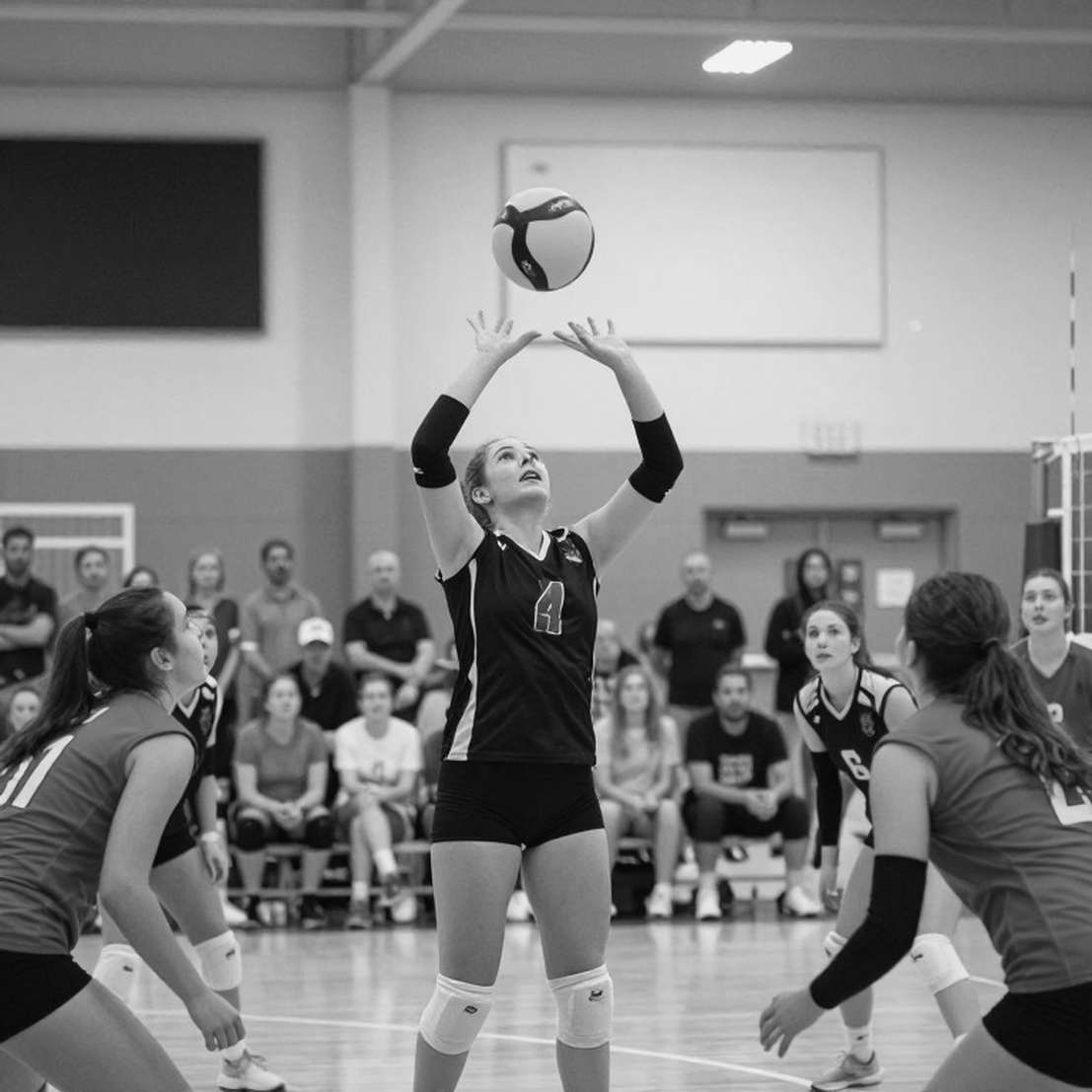
For Vietnam's women's team, the question is which style we are trying to block in. The answer is not in squad height, but in whether the back court is given information before the rally.
The blind spot is not on the court
I learned to find opponents' blind spots from my own.
In 2026, reviewing data on a V.League opponent, I found a pocket of space they always exposed when pushing up. I proposed exploiting it, and we won that match with both goals coming from long switches launched by centre-backs. But the bigger lesson was not the win. It was realising I only found their blind spot after admitting my own: our team exposed exactly the same pocket when pushing up, except nobody exploited it.
In volleyball, the mechanism repeats. Vietnam's women's team is exploited in Zone 5 after a dragged block, but the right question is not how to seal Zone 5. The right question is: is our opponent exposing a similar zone, and are we attacking it?
The blind spot is not on the court. It is in the head of the person watching the footage.
What to verify in the next match
If the analysis above is right, we should see three signals in the next match.
First, the number of deep cross-court attacks into Zone 5 after the block is dragged right should fall, replaced by more attacks into Zone 1. If that happens, the coaching staff has adjusted the libero's base position.
Second, the share of balls our setter has to run for in Zone 2 should drop, meaning the number of quick middle options rises.
Third, the number of block touches, not successful blocks but mere deflections that change the ball's direction, should rise. That is the metric I believe matters most over the next six months.
Data does not lie, but it only answers the question you ask. And the right question for Vietnam's women's team right now is not how strong we are, but how many beats ahead our system can read the opponent.